


I want to buy a caravan - where do I start?
- weplanyoucaravan
- Mar 31, 2024
- 10 min read
Updated: May 18
There is a bewildering range of styles, layouts, sizes, and construction materials on the market, so before buying a caravan we recommend a lot of homework!
Families wanting to take the kids for weekend trips to caravan parks are in the market for a very different caravan to grey nomads who wish to live on the road in free camps. Here are some tips to help you interpret what you want and need in a caravan.
LETS START AT THE VERY BEGINNNING... A VERY GOOD PLACE TO START...
Caravans can be a big investment! Not only is there the initial cost of the caravan, but also keeping a vehicle that can capably tow it. Not to mention ongoing registration, insurance etc. If you buy a caravan, then decide caravanning is not for you... or if you buy the wrong caravan to suit your needs - you can lose a significant amount of money.
If you are unfamiliar with the industry and holiday style, here are some suggestions for how to get started
Go for a weekend or longer holiday to a caravan park but stay in a park cabin (most caravan parks have them). While you are there, explore the lifestyle. Wander around and talk to caravan owners and ask questions, look at setups etc. Most of us are a super friendly bunch and will be happy to chat for hours over a beer or two or while watching kids at the playground or pool. This will give you a feel for whether you enjoy this type of holiday.
Hire a caravan or motorhome for 1 or 2 trips to get a feel for travelling this way. Again, chat to others along the way for advice and wisdom. This will also give you a feel for how much this type of holiday costs.
Don't feel you have to start with everything brand new with all the bells & whistles. You may want to enter the market for a year or two with an older, cheaper caravan while you determine if its for you. We began with an old caravan when our kids were very young - ended up owning it for 12 years, towed it all over Australia, and had an absolute ball!!
TIP: All caravanners and sales people believe that their caravan and tow vehicle are the best :-) You will need to decide the right choices for you and your family as we all camp differently!
WEIGHTS AND TOWING
One of the first things you need to wrap your head around, and also the most confusing, are the myriad of weights involved. All of these pertain to towing and are designed with safety in mind.
The bottom line is you must ensure your vehicle can legally tow your caravan. If you intend to use a current vehicle, check its maximum towing capacity. Your vehicle's manufacturer will have specified the following relevant weights
Kerb Weight - the mass of the vehicle in running order unoccupied and unladed with all fluid reservoirs, including fuel, filled to nominal capacity and with no accessories fitted (accessories include bull bars, roof racks, tow balls etc)
Gross Vehicle Mass (GVM) - this is what the vehicle's manufacturer dictates is the maximum your vehicle can weigh when it is fully loaded. This must take into account any accessories (bull bars, roof racks, etc) + passengers + luggage. Should you need to file an insurance claim, your insurers will verify that the GVM has not been exceeded.
Gross Combination Mass (GCM) - this is what your vehicle's manufacturer disctates is the maximum weight allowed for both your vehicle and caravan combined.
When looking at caravans, relevant weights include
Tare mass or weight - this is the weight of your caravan when completely empty as provided by the caravan manufacturer. This figure includes the standard features originally added by the manufacturer (but not any aftermarket accessories such as a bike rack). If an owner has modified the caravan in any way, legally they should get the tare updated (but this often does not occur). Tare does not include luggage, gas bottles, or liquid in any tanks.
Aggregate Trailer Mass (ATM) - set by the caravan manufacturer, this is the maximum weight the caravan can safely hold when fully loaded. Exceeding this weight is illegal and can result in an unsafe caravan. Should you need to file an insurance claim, your insurers will verify that the ATM has not been exceeded and is not over your vehicle's towing capacity.
Other relevant terminology includes
Tow ball weight - refers to how much pressure the caravan weight applies to the tow ball when connected to your vehicle. Several factors can affect this weight including how your caravan is loaded, where heavy items such as appliances, water tanks and batteries are positioned, what is in storage compartments and the position of the axles.
Payload or load-carrying capacity - this is the amount you can add to either your vehicle or caravan. For vehicles, this is the kerb weight subtracted from the GVM. For caravans, subtract the tare from the ATM. This is the maximum amount of "stuff" you can carry and includes accessories such as bull bars, bike racks, roof racks, portable fridges, and stone guards. For your vehicle it includes people and luggage (either in the boot or on roof), and for your caravan it includes clothes, food, water, gas, bedding, bbqs and anything else you put in.
Consider what type of caravanner you may be. Are you a weekend only camper who likes to take the minimal amount of "stuff", or do you like all your creature comforts including coffee machines, vacuum cleaners, big screen tvs etc ? You will need to estimate the weight of all this "stuff" and ensure your caravan and tow vehicle have the payload to accommodate.
We recommend weighing any vehicle or caravan before purchase, especially if its second-hand. You can do this either at a public weighbridge or there are mobile weighing companies that will come to you.
NOTE: This section is a very simplistic view of weights and towing. Please do your own research to ensure you are legal and safe when towing a caravan.
TIP: Do not believe car or caravan sales people regarding weights without doing your own research - some will unfortunately tell you anything to get a sale (and most marketing material is targeted at sales without giving you all the information).
WHAT TYPE OF CAMPER ARE YOU?
Newcomers often prefer to caravan park hop, enjoying power and water hookup, communal facilities, pools, and kids playgrounds. Some caravan parks even have ensuite sites! A small on-road caravan with standard suspension, basic kitchen/living/sleeping spaces and no ensuite works very nicely for these campers.
If you want to venture off the beaten track or free camp, an off-road caravan can offer
heavy duty suspension for rough tracks
greater protection for the front and underbody (in the form of stone guards and checkerplate aluminium cladding)
water tanks
Toilet and shower (ensuite)
solar panels and a battery management system for off-grid power
grey water catchment
articulated off-road coupling
tougher wheels and tyres
SIZE
Consider the size of your family - are you a solo traveller, retired couple, family of 5, or family of 2 with a pet? Also, how will you be using your van - weekend trips a couple of hours from home, 2-4 week holidays per year, or living on the road and "doing a lap"?
Entry-level options include camper trailers or small pop-top caravans (where the roof "pops" up by a foot or two). Some models even have fold out ends for extra space. These are popular entry level options, especially for families who require more space for weekends and annual holidays. These options rarely include toilets and showers.
Larger caravans offer more layout choices, bigger kitchens, more storage, toilets & showers. Beds set across the width of the caravan (called east-west beds) save space but require one person to climb over the other and can frustrate the person having to change sheets regularly. Beds running length-wise (called north-south beds) offer easier access but take up valuable real estate.
Make a list of your wants and needs. Put only things you must have under needs and be prepared to cut from the wants list should it blow your budget. Consider the importance of a toilet/shower, air conditioning, heating, plush interiors fittings, slide out BBQ, coffee machine, and washing machine.
Don't forget to consider where you are going to park your caravan when it's not in use. This can dictate the maximum length and height.
BUDGET
What will you get for your money?
Up to $50,000 - These will be either older caravans or smaller models. Likely they will have fewer bells and whistles and are unlikely to have a toilet and shower. You will get a kitchen and beds.
Between $50,000 to $100,000 - You will find plenty of family or couples vans in this price bracket. You will be able to get a good quality second-hand van from a reputable manufacturer with ensuite, larger living space and possibly features like air conditioning, tv, water tanks. You could also get a new van, but it may be a smaller onroad model, or a model from a lesser known manufacturer.
From $120,000+ - For this budget you will have your choice of new, good quality caravans. You could select between on- and off-road models with a layout customised for your needs, possibly including features like washing machines and battery management systems.
Options for how to fund a caravan purchase
Save, save, save!
Caravan finance
Property equity
Sell your house
OUR ADVICE - Set your budget and stick to it! There is no point in over-spending on a caravan if it leaves you with no money to actually travel in it!
TIPS FOR BUYING SECOND-HAND
There are online services in each state that allow you to check a caravan's rego number or VIN to obtain the history (also called a PPSR check). These services can provide valuable information such as whether the vehicle has been stolen, previously written off, has had past water damage, or if there is currently finance owing. The Australian Government web site www.vehiclerecalls.gov.au can provide information on whether there has been any safety recalls issued for that make & model caravan. All useful information that may influence your decision to purchase.
With long warranties from manufacturers, some caravans are on-sold during the warranty period. Note this warranty is not always transferrable to a new owner or certain conditions may need to have been met for it to still be valid. Its always worth a phone call to the manufacturer to check.
You can search for second-hand caravans at local dealerships/manufacturers or online marketplaces such as "Caravan Camping Sales", Gumtree, Facebook Marketplace, or Buy/Sell Facebook groups.
If you have selected one or two manufacturers/models that you think will be ideal for your family, then be patient and wait for the perfect van to come available. Have your finances lined up, your tow vehicle ready, and searches turned on to email you any new listings. Your patience will be rewarded.
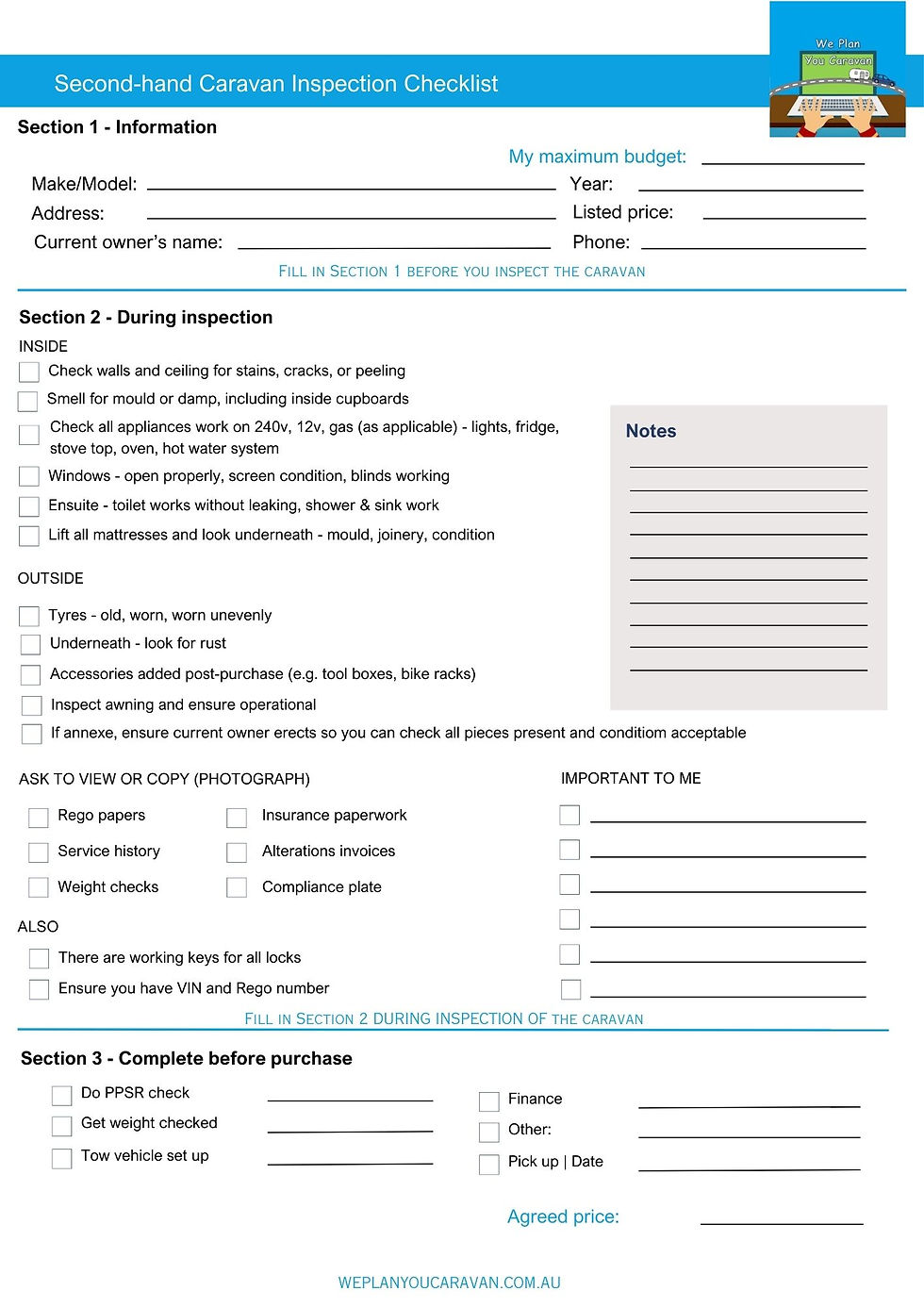
Always inspect a second-hand caravan personally. Things to look out for include:
Stains, cracks or peeling ceiling or wall panels (especially under windows and in corners) as this is likely from a water leak.
Smell of mould or damp, again an indication of water ingress. Check inside all cupboards.
Old or worn tyres. If tyres are worn unevenly, this is indication the caravan may require a wheel alignment. The manufacture date on the tyres should be less than 4 years old else blow outs can occur even if tread is good.
Rust underneath the caravan - check A frame, springs etc.
Accessories that have obviously been added post-purchase (eg. tool boxes, bike racks), be wary of how these may affect the weight
Other things to personally check:
Ensure all appliances work on 240v, 12v, gas (as applicable). Check lights, stove top, hot water system, fridge.
Do all windows open properly and blinds work as expected?
If an ensuite model, check that the toilet works correctly without leaking, check the canister etc. Does the shower and sink work as expected.
Lift all mattresses and look underneath. Make sure there is no mould plus both the joinery and underside of mattress are in a condition acceptable to you.
It has working keys for all locks.
Awning is operational and inspect condition.
If there is an annexe, ensure the currently owner erects it for you so that you can check all the pieces are there, that it fits, and is in good condition (check for mould etc).
Ask for paperwork on service history.
Personally, we would always get a second-hand caravan weight checked, if it has not been done recently, before purchasing any caravan - as you never know what extras have been added to the caravan or if it still complies with its compliance plate and registration paperwork. A reasonable seller will understand why you are asking for this, it just like getting a property inspection report before buying a house.
Be wary of caravans that have water damage or rust.
Here is a checklist that you can take with you when looking at second-hand caravans.
LAST BUT NOT LEAST
Assess your existing towing experience. There is no shame in selecting a smaller caravan if you are not comfortable towing a massive heavy thing. Safety on the road is paramount and at the end of the day YOU will be the one towing it across steep windy country mountain ranges, in holiday traffic, on tight city streets and busy highways... not to mention reversing into pokey caravan park sites. If you haven't towed before, consider a towing course.
Don't be afraid to ask other campers about their set up, most are happy to tell you about their experiences. This could be done in person (e.g. at caravan parks) or on social media groups and forums. Often owners will give you a much more realistic opinion about a given brand than salespeople.
Don't rush your decision!!! I can't stipulate this loud enough. I have talked to too many people who have visited a caravan and camping show for the first time only to come away having put a deposit on a brand new van without thinking it through... "oops my current vehicle can't tow it", "I don't get it for another 12 months" (that turns into 2 years), "my kids will grow out of those bunks in 2 years", "I need to buy a truck to tow it". Caravan and camping shows are a great place to compare lots of different caravan layouts, brands, and models, but they are also swarming with sales people - who work off commission - keen to get you signing on the dotted line.

DISCLAIMER: We Plan You Caravan have taken all reasonable steps to ensure the accuracy of the information contained in this document, however, we can give no guarantees regarding the accuracy, reliability, suitability, availability or completeness of the content. Especially when it comes to current prices, addresses, phone numbers, website addresses, days of operation, and opening hours. We Plan You Caravan are not affiliated with any accommodation providers or suppliers mentioned and the onus is on the customer to select their chosen supplier and agree not to hold We Plan You Caravan responsible should any of these suppliers: 1) Fail to provide the services purchased; 2) fail to comply with any applicable law; 3) engage in any negligent act or omission that causes any sort of injury, damage, delay or inconvenience. We Plan You Caravan is not responsible for, nor will it be held liable for, any injury, damage or loss suffered on account of any conditions, actions or omissions experienced. Travel may involve the risk of a variety of hazards to health and/or safety, including but not limited to disease, crime, terrorism and warfare. Because each traveler’s risk tolerance is different, We Plan You Caravan is not in a position to advise or recommend whether travel to any particular place or at any particular time should take place.
COPYRIGHT POLICY: Unless otherwise noted, We Plan You Caravan is the legal copyright holder of all written, multimedia, and graphic information published and it may not be shared, reprinted, modified or published without written consent.


Great info!
Thank you, very helpful and informative